Bank Regulation: Fed Approves Santander's Webster Acquisition
The Federal Reserve Board approved Banco Santander's application to acquire Webster Financial, with Santander Bank set to become Connecticut's largest bank.
A bank holding company merger approval is the Federal Reserve’s formal sign-off under the Bank Holding Company Act, and on August 4, 2026 the Board approved Banco Santander, S.A. and Santander Holdings USA’s application to acquire Webster Financial Corporation of Stamford, Connecticut.
Key takeaways
- The Board approved the application of Banco Santander, S.A. (Madrid) and Santander Holdings USA, Inc. (SHUSA, Boston) to acquire Webster Financial Corporation and, indirectly, Webster Bank, National Association.
- Santander Bank would become the largest insured depository institution in Connecticut, with about 23.8 percent of the state’s deposits.
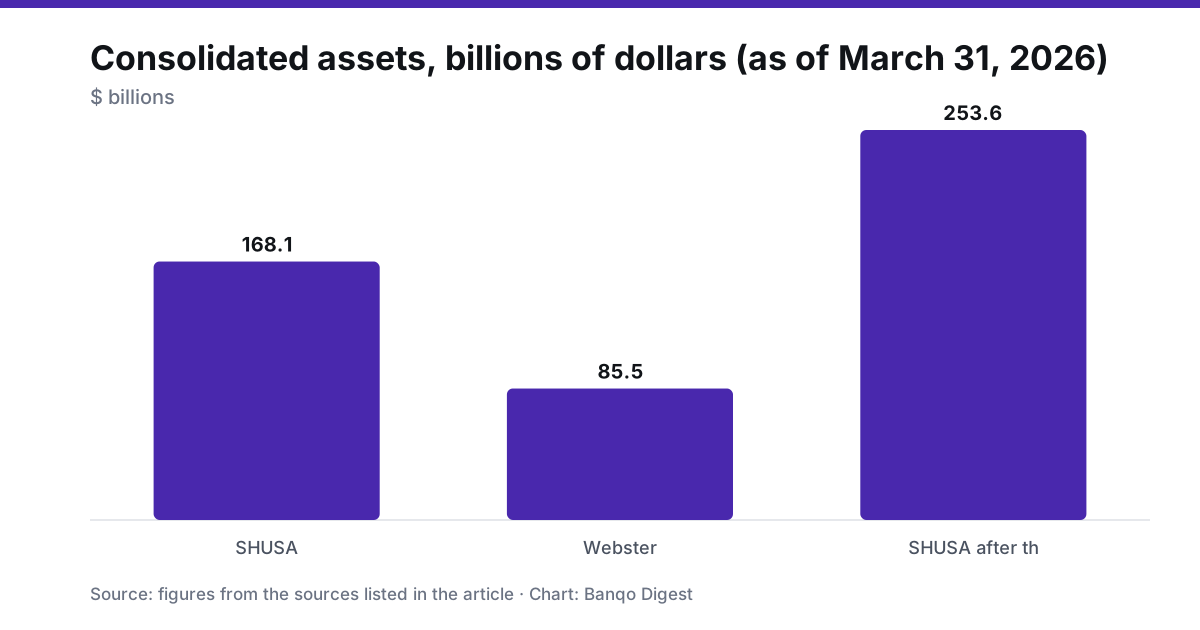
- SHUSA would become the 19th largest insured depository organization in the United States, with about $253.6 billion in assets.
- The Board received four adverse comments and found the factors in the law consistent with approval.
What happened
The Board announced the approval at 4:30 p.m. EDT in FRB Order No. 2026-19. Webster would be merged into SHUSA, and Webster Bank would be merged into SHUSA’s national bank subsidiary, Santander Bank, National Association. The OCC approved the bank merger on June 12, 2026, according to the order. Applicants also filed notice to acquire Webster’s interests in three nonbank companies engaged in financial and investment advisory activities.
The numbers behind the order
As of March 31, 2026, SHUSA had about $168.1 billion in consolidated assets and was the 31st largest insured depository organization. Webster had about $85.5 billion and ranked 41st. Combined, SHUSA would hold about $253.6 billion and about $150.3 billion in deposits, each less than 1 percent of the U.S. total. Banco Santander, the parent, has about $2.1 trillion in consolidated assets.
Connecticut is where the two banks overlap most. Webster Bank is the second largest in the state with about $40.4 billion in deposits, or 22.8 percent. Santander Bank holds about $1.9 billion there. After the merger, Santander Bank would hold about $42.3 billion in Connecticut. The banks also overlap in Massachusetts, New York and Rhode Island, where Santander would remain fourth in Massachusetts and rise to 11th in New York.
How the Board decided
The Bank Holding Company Act requires the Board to weigh competition, the financial and managerial resources of the firms, the convenience and needs of the communities served, financial stability and, for a foreign bank, comprehensive consolidated supervision at home. On competition, the order says that in each affected banking market either the market would not be highly concentrated under the Herfindahl-Hirschman Index or the change would fall within the 1995 Bank Merger Guidelines and Board precedent.
On community needs, both banks hold “Outstanding” Community Reinvestment Act ratings from the OCC. Commenters had argued the deal could lead to branch closures and less access to credit. The Board concluded the convenience and needs factor was consistent with approval.
On financial stability, the order says the deal would raise Santander’s combined U.S. assets by about 33 percent to around $335.3 billion, still roughly 1 percent of the U.S. financial system, and would not appear to result in meaningfully greater or more concentrated risk. SHUSA would also move from Category IV to Category III under the Board’s enhanced prudential standards, and the order says it reviewed the firm’s plans to comply with them.
Key terms
- Bank holding company: a company that controls one or more banks and is supervised by the Federal Reserve.
- Herfindahl-Hirschman Index (HHI): a measure of market concentration used in competition review.
- Community Reinvestment Act (CRA): the law that requires banks to meet the credit needs of their communities.
FAQ
Is this the final approval?
The Board’s approval is one step. The order notes the OCC approved the bank merger on June 12, 2026.
Will branches close?
Applicants told the Board that the legacy branch networks overlap and that Santander Bank may consolidate some branches, but that no final decisions have been made. They said they would consider the effect on low- and moderate-income communities.
Prepared with AI assistance from the public documents listed above and reviewed under our editorial policy. Not investment advice.